

Texas company search helps users check existing LLC records and review business names filed with the Texas Secretary of State. An LLC name lookup can show whether a similar business name appears in state records before a new company is formed. Search results may include the entity’s legal name, filing number, status, formation details, and other public record information. This type of search can support business name research, company verification, and preliminary checks for entrepreneurs considering a new Texas LLC.
Texas company search can help users locate an existing limited liability company by searching available business information. A Texas LLC lookup may be useful for checking whether a proposed name resembles an existing entity name or for confirming details about a registered company. Search results can help identify the correct entity among businesses with similar names. State records may contain information such as entity status, registered agent details, filing history, and formation date, giving users useful facts for business research and record verification.
How to Perform a Texas LLC Search
A Texas LLC Search can help you locate and review records for a limited liability company registered or recorded in Texas. A Texas Company Search can provide another way to identify the business using its available records and registration details. Depending on the information available, you may search by the LLC’s legal name, file number, or tax-related identifier. Reviewing both Comptroller and Secretary of State records can help you identify the correct LLC and understand the information available for that business.
- Texas SOSDirect — Official Business Search:
- https://www.sos.state.tx.us/corp/sosda/index.shtml
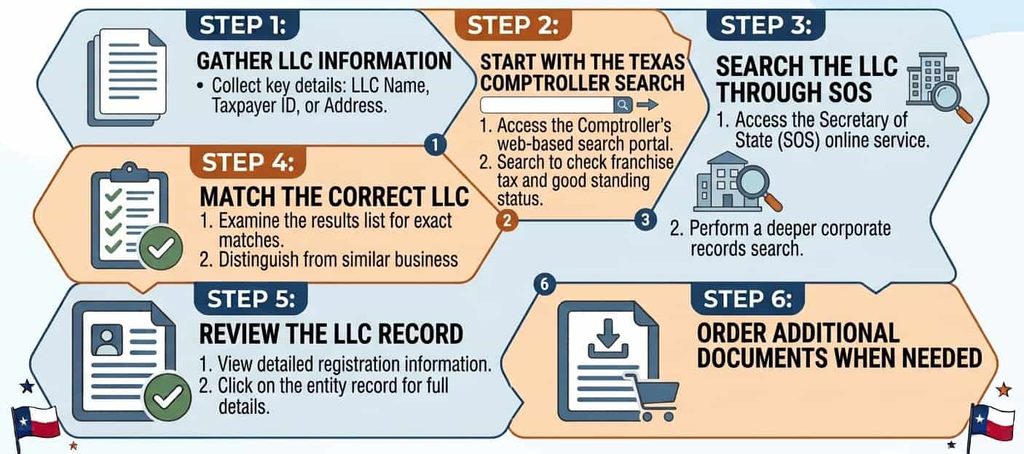
Gather the LLC Information
Before starting a Texas LLC Search, collect any information you already have about the business. More than one identifier can help narrow the results and distinguish similar companies.
Useful information may include:
- LLC name
- Partial business name
- LLC file number
- Texas taxpayer number
- Federal EIN, where supported
- Registered agent
- Member or manager information, where the applicable search permits
Start With the Texas Comptroller Search
The Texas Comptroller search can help locate a taxable entity record using available business information. Start with the entity name if you do not have a specific identification number. Review the matching businesses and compare the legal name with the information you already have.
You may use information such as:
- Entity name
- Taxpayer number
- Texas SOS file number
- Federal EIN, where supported
Search the LLC Through SOS
After checking the Comptroller record, you can search the LLC through the Texas Secretary of State’s SOSDirect system. Enter the entity name or use the LLC file number when it is available. A file number can provide a more precise way to locate a particular Texas limited liability company.
The Texas SOS search can help you review:
- Texas LLC Search results
- LLC legal name
- Entity type
- LLC file number
- Texas LLC records
- Filing information
Match the Correct LLC
A business name alone may not be enough to identify the correct LLC. Similar or related names can appear in search results, so compare several identifying fields before selecting a record.
Check:
- Legal name
- Entity type
- Entity status
- File number
- Formation date
- Registered agent
- Address
Review the LLC Record
Once you identify the correct business, review the available entity record carefully. Look at the legal name, entity status, formation information, registered agent, registered office, and file number. Available filing information can provide additional context about the company’s registration history.
Depending on the record, review:
- Entity information
- Formation date
- Registered agent
- Registered office
- Filing history
- Document images
- Assumed names or other available names
Order Additional Documents When Needed
If basic entity information is not enough, Texas SOS provides options for obtaining additional business records and certificates. Depending on the document required, users may be able to request copies or certificates through the Secretary of State’s business-record system.
Documents include:
- Filing history
- Certificate of Formation
- Certificate of Fact
- Certified copies
- Filing records
Where Can You Search for a Texas LLC?
A Texas LLC can be checked through two main state systems: the Texas Secretary of State business-record system and the Texas Comptroller Taxable Entity Search. Each system maintains different types of information. The Secretary of State focuses on business registration and filing records, whereas the Comptroller focuses on taxable entity and franchise tax information. The right source depends on whether you need registration records or tax-related status.
Texas Secretary of State Search
The Texas Secretary of State maintains records for Texas business entities, including LLCs. SOSDirect has provided online business filing and search functions for entity records, including searches by entity name and filing number. Available records can contain the LLC file number, formation date, registered agent, filing history, and filed documents such as a Certificate of Formation. SOSDirect searches currently carry a $1 statutorily authorized search fee; the fee is waived when an order or filing is placed from the search results. Important 2026 update: Texas is transitioning from SOSDirect and SOSUpload to the new SOSPortal system on September 29, 2026. For website content, refer to the current Texas Secretary of State system and update the link as the transition takes effect.
Use the Secretary of State search for:
- LLC registration records
- LLC file number
- Formation date
- Registered agent
- Filing history
- Certificate of Formation
Texas Comptroller Taxable Entity Search
The Texas Comptroller Taxable Entity Search focuses on taxable entity and franchise tax information. The search can be used with an entity name, Texas taxpayer number, or Texas SOS file number. The results can provide information related to the entity’s tax account, right to transact business, and other Comptroller records. The search is available online without a search fee.
Use the Comptroller search when you need:
- Entity name
- Taxpayer number
- SOS file number
- Taxable entity information
- Franchise tax status
- Right to transact
- Tax-related status
What Information Can You Find in a Texas LLC Search?
A Texas LLC Search can show several details tied to a limited liability company in Texas. The information depends on which state record you review and what documents have been filed. Secretary of State records focus on entity registration and filings, whereas Comptroller records focus on taxable entity and franchise tax information. A search may show the LLC legal name, file number, formation date, status, registered agent, governing persons, filing records, certificates, and tax-related information.
LLC Legal Name
The LLC legal name is the official entity name recorded with the Texas Secretary of State. A Texas LLC Search may display the entity name used in formation or later filings. This legal business name can differ from a trade name or assumed name used by the company. Comparing the LLC name with other record details helps identify the correct business.
LLC File Number
The LLC file number is an identification number assigned by the Texas Secretary of State. It can help locate a particular business when several entities have similar names. A search using the file number can be more precise than a name-only search. The SOS file number is used in various Secretary of State filings and entity records.
Formation Date
The LLC formation date identifies when the Texas entity was created through its formation filing. The Certificate of Formation contains the information submitted to create the LLC, and the resulting record can show the formation date. This date can help distinguish businesses with similar names and provide a basic point of reference for the entity’s registration history.
LLC Status
LLC status describes the condition of the entity shown in the applicable state record. Depending on the record, terms may include active, in existence, forfeited, or terminated. A tax forfeiture can involve the entity’s right to transact business, so a status shown by the Comptroller should not automatically be treated as the same type of status shown in Secretary of State records.
Registered Agent
A Texas LLC record can identify the registered agent and registered office connected with the entity. The registered agent is the person or entity designated to receive service of process for the LLC. The registered office must be a Texas street address where service can be made during normal business hours. Texas requires an LLC to maintain both.
Member or Manager Information
Texas LLC formation records can contain information about governing persons. If an LLC is formed with managers, the Certificate of Formation provides the name and address of each initial manager. If it does not initially have managers, the filing provides the name and address of each initial member. This does not mean every public record provides a complete ownership structure or current list of all members.
Filing History and Certificates
A Texas LLC search can lead to filing records connected with the entity. Depending on the record, these may include a Certificate of Formation, amendments, certificates of filing, and other submitted documents. A certified copy is an official copy prepared by the Secretary of State under its copy-order process. Filing history can help show changes made to the entity record over time.
Taxable Entity Information
The Texas Comptroller maintains taxable entity records that are separate from Secretary of State registration records. A Comptroller search can show information tied to the taxable entity, franchise tax account, and right to transact business. This information can help explain the entity’s tax-related standing, but it does not replace the LLC’s Secretary of State filing record.
How to Check Texas LLC Name Availability
Checking a proposed name is a separate task from reviewing an existing LLC. A Texas LLC Name Search can help identify names already appearing in Secretary of State records and names that may conflict with existing filings, reservations, or registrations. Texas law requires covered entity names to meet the state’s distinguishability rules. The Secretary of State makes the final determination after receiving and processing the filing.
Search the Proposed LLC Name
Start a Texas LLC name lookup with the full proposed LLC name. A Texas LLC Name Search can show whether the name appears in Secretary of State records and whether similar names require closer review. Search the LLC business name in Texas using the wording you plan to submit, including the proposed organizational designation. A search result can provide useful preliminary information, but it does not establish final approval by the Secretary of State.
Search More Than the Exact Name
A single exact-name search may not provide enough information for a proposed business name. Compare variations that could produce related results, such as:
- Singular and plural forms
- Similar wording
- Alternate word order
- Punctuation differences
- Common abbreviations
- Different LLC entity designators
Texas’s Distinguishable Name Rule
Texas requires the name of a filing entity, including a Texas LLC, to be distinguishable in the Secretary of State’s records from certain existing names. The rule covers existing filing entities, foreign filing entities registered to transact business in Texas, certain fictitious names, existing registered series of a Texas LLC, and names that have been reserved or registered with the Secretary of State. Texas administrative rules set out how names are evaluated as distinguishable, the same, or available with consent. A proposed name may still require review if an existing entity has similar wording. A reserved name can affect availability, and an assumed name can have a different role from the entity’s legal name. Texas naming rules apply to the legal entity name recorded with the Secretary of State. A preliminary name inquiry can provide information, but it does not create final approval.
A Search Result Is Not Final Name Approval
Search result ≠ legal approval.
A Texas LLC name search is useful for preliminary checking, but the result does not guarantee that the proposed name will be accepted for filing. The Texas Secretary of State states that a final determination cannot be made until the filing document is received and processed. A preliminary clearance or name reservation does not authorize use of a name in violation of another person’s rights. For that reason, treat a search result as an indication for further review rather than a final decision on name availability. The Secretary of State makes the formal determination during the filing process.
Texas LLC Naming Rules to Know Before Filing
Texas LLC naming rules affect whether a proposed business name can be filed with the Secretary of State. A name search can show existing records, but the proposed name must meet Texas requirements at filing. Key areas include the required LLC designator, distinguishability from existing entity names, restricted wording, and situations where consent or administrative review may apply. The Texas Secretary of State applies the Business Organizations Code and administrative name-availability rules when reviewing an LLC name.
Required LLC Designator
A Texas LLC name must include an approved organizational designation when the formation document is filed. The Texas Secretary of State lists Limited Liability Company, Limited Company, L.L.C., L.C., and Ltd. Co. as acceptable designations for a limited liability company. Abbreviations may be used with or without punctuation. A name reservation does not need the designation, but the designation must appear on the Certificate of Formation when required.
Names Must Be Distinguishable
A proposed LLC name must be distinguishable in the Secretary of State’s records from certain existing entity names, foreign entities registered in Texas, registered series, name reservations, and name registrations. When checking name availability, compare the proposed LLC name with existing LLC name records and other covered entities. A name that appears different at first glance can still require review under Texas naming rules.
Restricted or Regulated Terms
Some wording can create a filing issue if it suggests that an LLC performs a business activity it is not authorized to conduct or falsely suggests an affiliation with a governmental entity. Texas law addresses these types of wording directly in the LLC formation requirements. When reviewing name availability, pay attention to terms that describe regulated activities or government connections rather than treating every available-looking name as automatically acceptable.
Similar Names and Consent
Texas name rules can classify names as the same, deceptively similar, similar, distinguishable, or available with consent under the applicable administrative rules. A proposed name that raises a conflict may require further review or appropriate consent before filing. The Secretary of State provides preliminary name-availability inquiries, but the final determination is made after the filing document is received and processed.
Texas LLC Name Reservation
A Texas LLC name reservation lets an applicant hold an entity name for a limited period before forming or registering the business. The reservation process is separate from LLC formation. Texas Secretary of State materials state that an entity name may be reserved for 120 days, with renewal available during the 30-day period before the current reservation expires.
What Is a Texas Name Reservation?
A Texas name reservation is filed using Form 501, Application for Reservation or Renewal of Reservation of an Entity Name. The reservation places the selected name on record for the reservation period. The current filing fee listed by the Secretary of State is $40, and the reservation lasts 120 days. A renewal application can be filed during the 30-day period before expiration. A reserved name can help hold a proposed business name for later formation, but the reservation itself does not create an LLC.
Does a Name Reservation Create an LLC?
No. A name reservation only holds the entity name for the applicable reservation period. It does not create a Texas LLC, establish limited liability, or replace the Certificate of Formation. The LLC comes into existence through the required formation filing with the Texas Secretary of State. A reserved name must still meet the applicable requirements when the formation document is submitted.
Texas LLC Search vs. DBA or Assumed Name Search
A Texas LLC Search looks for the legal entity recorded with the Texas Secretary of State. An assumed name search looks for a business name used by an LLC that differs from its legal business name. Texas calls this an assumed name, often referred to as a DBA. An LLC using an assumed name must file an assumed name certificate with the Secretary of State.
How to Read Texas LLC Status
A Texas LLC search can show a status that needs some context before it is interpreted. Secretary of State records focus on the LLC’s legal existence and filing record, whereas the Texas Comptroller’s Franchise Tax Account Status focuses on the entity’s right to transact business. These are related records, but they are not the same status field. A Texas LLC may have an “in existence” status with the Secretary of State and a separate franchise tax status shown by the Comptroller.
Active or In Existence
An in existence status on Secretary of State records indicates that the LLC exists as a Texas entity. Texas SOS materials describe “in existence” as an active status. This status relates to the entity’s legal existence in the Secretary of State’s records. It should not be treated as the same thing as a current franchise tax account status or proof of tax compliance.
Good Standing / Right to Transact
The Texas Comptroller uses Franchise Tax Account Status to show an entity’s right to transact business in Texas. The Comptroller notes that this status was previously referred to as “Good Standing.” It reflects the Comptroller’s franchise-tax records and can be affected by required tax filings or payments. A Comptroller status should be read separately from the LLC’s Secretary of State entity status.
Forfeited Existence
A forfeited status can relate to tax or filing problems and should be read based on the agency showing the result. The Comptroller can forfeit an entity’s right to transact business when required franchise tax obligations are not met. Secretary of State records can separately reflect tax forfeiture or related registration consequences. A forfeiture is not the same as a voluntary termination.
Voluntarily Terminated
Voluntarily Terminated means the entity’s owners or governing authority completed the required termination process and filed a certificate of termination with the Secretary of State. Texas SOS instructions state that the entity’s status changes to “Voluntarily Terminated” when the applicable termination filing becomes effective. This status concerns the LLC’s legal existence and should not be confused with a Comptroller tax-status result.
SOS Status vs. Comptroller Status
When reading a Texas LLC record, check which agency produced the status:
| Record | What the status relates to |
|---|---|
| Texas Secretary of State | LLC existence, registration, and filing record |
| Texas Comptroller | Franchise tax account and right to transact business |
| SOS “In Existence” | Entity is shown as existing in SOS records |
| Comptroller “Right to Transact” | Tax-related authority to transact business in Texas |
Texas LLC Search Fees
Texas LLC search costs depend on which state system you use and whether you order additional documents. The Texas Comptroller’s Taxable Entity Search is available online for checking an entity’s tax-related status and right to transact business, with no separate search fee listed by the Comptroller.
Frequently Asked Questions
Texas Taxable Entity Search questions often focus on taxable entity records, taxpayer numbers, entity names, Federal EINs, and Texas SOS file numbers. The FAQs below explain how the Texas Comptroller search works, what information users may need for a search, and what types of tax account details can appear in the results. These answers can help clarify common questions about Texas taxable entity records and Comptroller search information.
What is the Texas Taxable Entity Search?
The Texas Taxable Entity Search is an online search provided by the Texas Comptroller of Public Accounts. It lets users check tax-related information for a Texas taxable entity. Search results can include the entity name, taxpayer number, right to transact business, SOS file number, registered agent, and registered office information. The results reflect Comptroller records available at the time of the search.
Is the Texas Comptroller taxable entity search free?
Yes. The Comptroller taxable entity search is available online without a search fee. Users can enter an entity name, taxpayer number, Federal EIN, or Texas SOS file number to locate a record. The Texas taxable entity search displays information maintained by the Comptroller, including tax account details and right-to-transact status. Separate fees may apply to other Texas Comptroller services or official documents.
What information do I need to search for a Texas taxable entity?
You can search for a Texas taxable entity using several identifiers. The available search options include:
- Texas taxpayer number
- Entity name
- Texas SOS file number
- Federal EIN
The taxpayer number identifies the Texas tax account, whereas the SOS file number identifies the related Secretary of State entity record. A Federal EIN can be entered in the Taxpayer Number field in the Comptroller search.
Can I search a Texas taxable entity by name?
Yes. The Texas Comptroller search allows users to search using an entity name. Enter the business name in the entity name field and review the matching records returned by the system. A taxable entity lookup Texas search can help locate the appropriate record when the taxpayer number or SOS file number is unknown. Compare the entity name with other displayed details to identify the correct business.
What is a Texas Taxpayer Number?
A Texas taxpayer number is an 11-digit identifier assigned by the Texas Comptroller to a taxpayer account. It helps connect a business with its Texas tax account and related Comptroller records. The taxpayer number is different from a Federal EIN and a Texas SOS file number. The Comptroller search can use this number to locate tax-related information for the associated taxable entity.